
From recruitment to interviews: an HRIS to manage the employee lifecycle
Four years later, a look back at a transformation that simplified the daily work of HR teams and managers, while simultaneously empowering employees.
Text: Marion Bois
Going Paperless, Gaining Efficiency
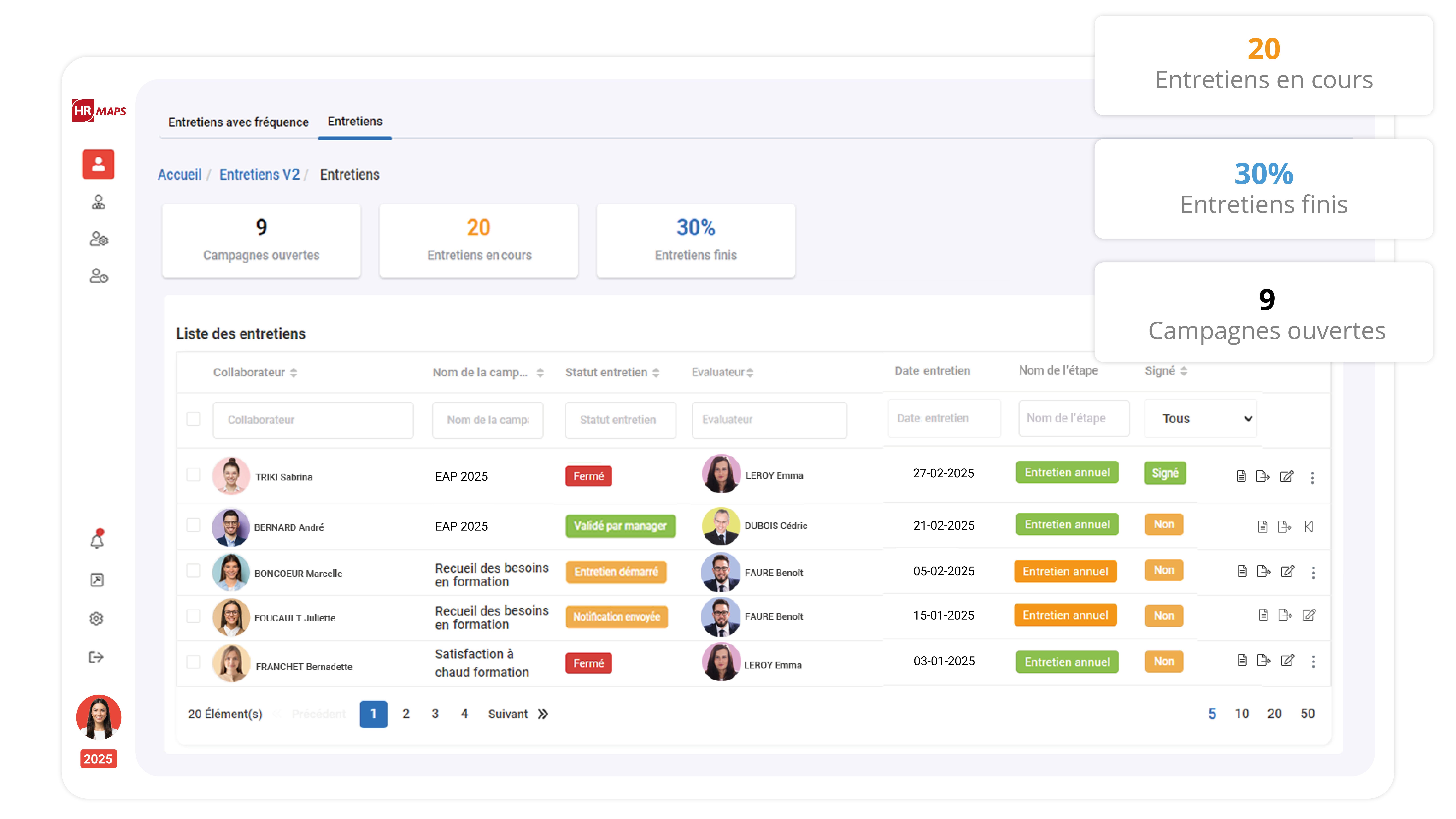
Before 2021, PCBS only had scheduling software. “We needed to take the next step to completely move away from paper,” explains Cathy Guyot, the facility’s HR manager. With the adoption of the HRMAPS solution, the HR team initiated a thorough reorganization: both for administrative aspects such as contract generation, digital payslips, and documents archived in a digital vault, and for talent management and regulatory compliance aspects with annual performance reviews (entered directly on a computer, tablet, or smartphone) and the tracking of mandatory training and qualifications. Every step is simpler.
“It’s easier and simpler for employees, for managers, and for us,” summarizes Ms. Guyot. The HRIS notably automates the scheduling of annual performance reviews, which employees prepare in advance. All employee-related documents (bank details, health insurance card, administrative paperwork, etc.) are now centralized and accessible to HR teams. The same applies to the automatic generation of employment contracts and the monitoring of the training budget and the Skills Development Plan. The HRIS is interfaced with payroll and time management software, eliminating the need for duplicate data entry. The result: substantial time savings and smoother daily operations.
A business solution designed for social and medico-social establishments and services (ESSMS)
For Rahma Kaaouana, Sales and Marketing Director at HRMAPS, the health, medico-social, and healthcare sector requires specific solutions. “We have designed a turnkey, ready-to-use solution with pre-configured settings tailored to the needs of ESSMS organizations, providing a concrete and comprehensive response to the challenges of digitalization and regulatory compliance for our clients.” This approach aims to facilitate customization and ease of use of the solution while controlling deployment time and cost. At PCBS, the initial configuration proved immediately relevant. “We then adapted it to our specific needs. This is important because we need to be as close as possible to our realities on the ground,” emphasizes Ms. Guyot. She also highlights the quality of the support provided: examples are sent, adjustments are made collaboratively, and the teams quickly develop their skills.
HR Management and Foresight**: Actionable Data at Last**
Thanks to the consolidation of HR data, the clinic now has precise management indicators: missing documents, tracking of authorizations, training requests, etc. “This allows us to better guide our long-term choices, particularly regarding skills management and investment in training,” explains Ms. Guyot. Employees, for their part, become active participants in their own development: they can consult the training catalog, express their preferences, and track their approval. “The tool really makes life easier for HR managers,” emphasizes Rahma Kaaouana. At the Polyclinique Basque Sud, this feature makes it possible to better understand the needs expressed by the teams while taking into account operational constraints and budgetary priorities. It’s a concrete way to involve everyone in their career path without increasing the management workload.