
Hopipharm in Nantes: the major event for hospital pharmacy
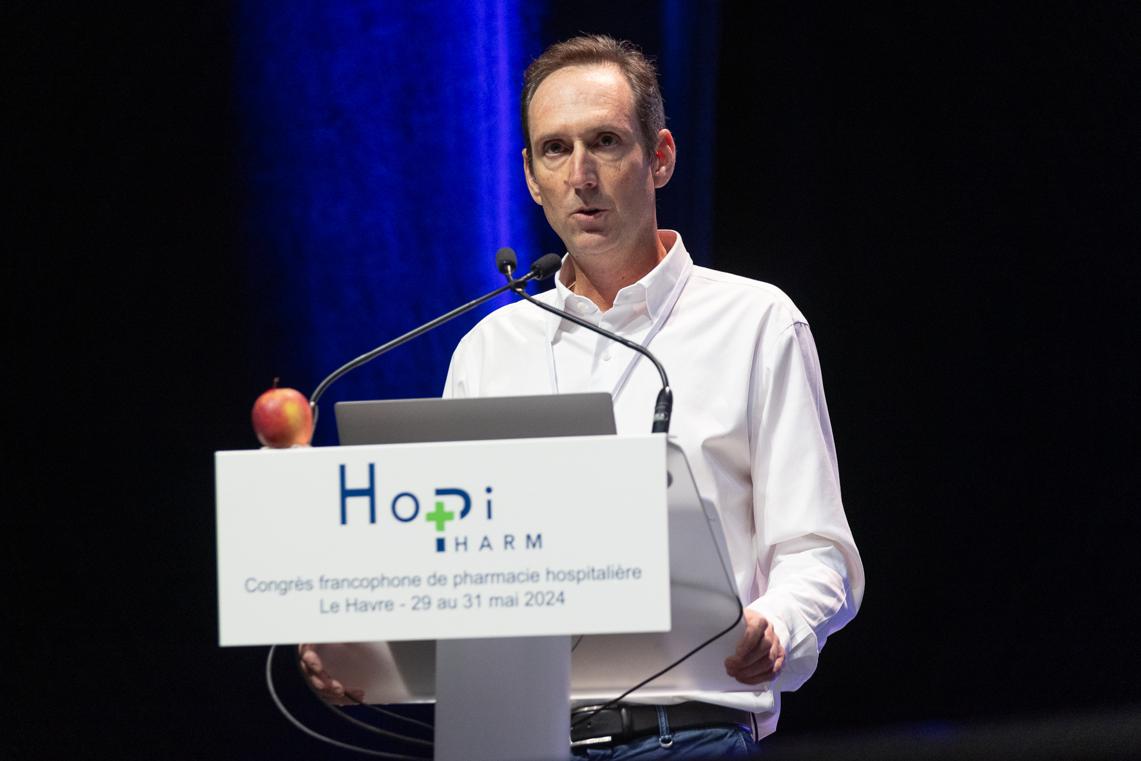
Some 1,400 visitors and around 100 exhibitors are expected for three days in Nantes, from May 21 to 23: Hopipharm confirms its status as a major annual event for French-speaking hospital pharmacy professionals. It’s an opportunity for professionals to take stock of the key issues of the moment. And also to broaden their perspectives, with an international focus (representatives from Switzerland, Belgium, Canada, and African countries will be present).
This event is all the more important as the profession must simultaneously address several challenges: technological
changes, digitalization and the rise of AI, medical demographics and human resource shortages,
the issue of the hospital pharmacy residency diploma (DES), not to mention broader societal concerns…
The program for the 2025 edition naturally reflects these concerns. Three main themes will take center stage during plenary sessions and/or workshops.
First, the development of digital technology in healthcare and the resulting upheavals. This broad topic, which is leading to a profound transformation of the profession, will be the subject of a session right from the opening on Wednesday, May 21. “Digital technology is still underdeveloped in our daily practice,” observes Cyril Boronad (Cannes Hospital), president of Synprefh (National Union of Pharmacists in Healthcare Facilities). “Generally speaking, our understanding of it remains imperfect and quite limited.
That’s why we want to support pharmacists and present them with solutions.” In this context, the rapid rise of AI is attracting attention. “AI will not replace professionals,” says Cyril Boronad. “But professionals who master AI could very well, in the coming years, take the place of those who don’t use it…” AI can prove very useful in various aspects of the profession, such as pharmaceutical decision support systems, but also in certain aspects of daily practice, such as referencing and bibliographies. “However, it’s essential to know how to use it wisely. We
will focus on analyzing the uses and potential benefits of AI and, again, on proposing solutions for professionals,” says the president. Finding a business model for AI will also be crucial…
The second major recurring theme is that of the “eco-responsible” pharmacist and CSR (Corporate Social Responsibility). Synprefh plans to publish a “Green Paper” on this topic this year, with practical guides for practitioners. Also of note is a high-level scientific conference on the issue of
the ecotoxicity of medicines, to be held on Thursday, May 22. Finally, the issue of quality of life at work and working conditions will feature prominently in the discussions – even if it will not be the subject of a specific session.
Synprefh has notably commissioned a master’s student to write a thesis on the integration of teleworking
within teams. “In the course of their work, our colleagues are frequently called upon for a wide variety of reasons and have to interrupt their tasks,” explains Cyril Boronad. “Allowing pharmacists to work remotely part of their time could be a solution – even if a complete shift in working hours is not being considered. A balance needs to be found.”
Concerns related to current events
Two other topics directly related to current events will also be discussed. The first is the defense of the specialized studies diploma (DES) for professional practice in hospital pharmacies. “For some time now, we have been witnessing attempts to undermine the conditions under which we practice our profession,” the pharmaceutical unions jointly denounce. Behind these criticisms lies the issue of pharmaceutical demographics. How can this be addressed? Should the number of interns be increased, and if so, how? On this question, Synprefh is working with the Ministry of Health on cooperation between hospital pharmacies. “Our concern is to combat the isolated practice of our profession,” Cyril Boronad reminds us.
“We support various forms of collaboration and the shared practice of our profession.”
Another “hot” topic is the current debate surrounding the law on end-of-life care and the “right to die.” “We are demanding the possibility for hospital pharmacists to invoke the conscience clause,” Cyril Boronad emphasizes. “They are currently the only healthcare professionals who do not benefit from this provision. This is illogical. Yet it is the pharmacist who will prepare the lethal compounded medication and dispense it.” The legislator must understand that pharmacists are healthcare professionals like any other, and that they are part of the healthcare team. Their role in clinical activities must be recognized. We cannot be asked to prescribe vaccines and then be deprived of this clause.
Moreover, a recent survey reveals that while a large majority (around 80%) of pharmacists want to benefit from this clause, only about 20% actually intend to use it. “We are not trying to block it,” emphasizes Cyril Boronad. In his view, it is primarily a matter of principle. And of fairness.
By J.-C. Lewandowski