
RFID at the heart of medical devices
The AP-HP (Paris Public Hospitals) recently opted to equip its medical devices with RFID tags to facilitate the daily tasks of its technicians regarding equipment location. A closer look at a technology that combines time savings and cost optimization for hospital facilities.
A FAST AND EFFICIENT IDENTIFICATION SYSTEM
The Asset Tracking software developed by RFID Discovery is an IT solution that could well address the challenges related to locating medical equipment. This platform processes data from various technologies (geolocation, Bluetooth, Wi-Fi, passive RFID, etc.) to provide visibility into the hospital’s medical equipment (furniture, medical devices). “This system operates as SaaS and therefore offers true interoperability with other software such as CMMS (Computerized Maintenance Management System),” explains Nicolas Bellemon, Sales Manager at RFID Discovery. “In the event of maintenance, the technician knows where the equipment is located, and the healthcare manager can also have an overview of their equipment.”
This solution primarily uses RFID, or radio-frequency identification, technology. This intelligent identification method reads, saves, and collects data remotely using RFID tags. The chip, or IC, contains the memory unit and a transceiver. The antenna is used to receive RF signals from a reader or to transmit its identification information. The substrate is the medium that binds everything together. In the hospital setting, RFID is used to optimize patient safety and monitoring, inventory management, and the traceability of medical devices, implantable medical devices, and other medical supplies.
AN EXAMPLE OF USE: INVENTORING
“On average, we know that healthcare staff spend 30 minutes a day looking for their equipment,” laments Oliver Blanckaert. It was this wasted time that the AP-HP (Paris Public Hospitals) initially sought to eliminate by equipping its medical devices with RFID tags. “Now, an inventory only takes about ten seconds.” “We can know the exact location of the equipment at any given moment, as well as its maintenance status,” the key account manager explains. Using a gun (a mobile RFID reader), it’s possible to inventory 93 medical devices in just 10 seconds by scanning the storage area. At the end of the inventory, the data appears on the software, indicating which devices require maintenance, which are not in their designated place, and which are missing.
A DEPARTMENT THAT IS GRADUALLY EQUIPPING IT
Antoine Dro and Laurent Siwiec, biomedical engineers at AP-HP Nord, explain that their initial need was to be able to geolocate hospital equipment in real time: “A wheelchair in the emergency department is never in a fixed location. Thanks to geolocation, healthcare staff know its exact location in real time,” says Laurent Siwiec. During their partnership, RFID Discovery frequently visited AP-HP (Paris Public Hospitals) to answer questions and conduct practical demonstrations. This strong collaboration resulted in equipping no fewer than 1,500 medical devices with RFID tags. The goal: “Everything inventoried in the CMMS (Computerized Maintenance Management System) will be tagged […] It’s become part of the maintenance workshop workflow,” explains Antoine Dro. RFID Discovery’s support enabled AP-HP to achieve a complete adaptation in a very short time.
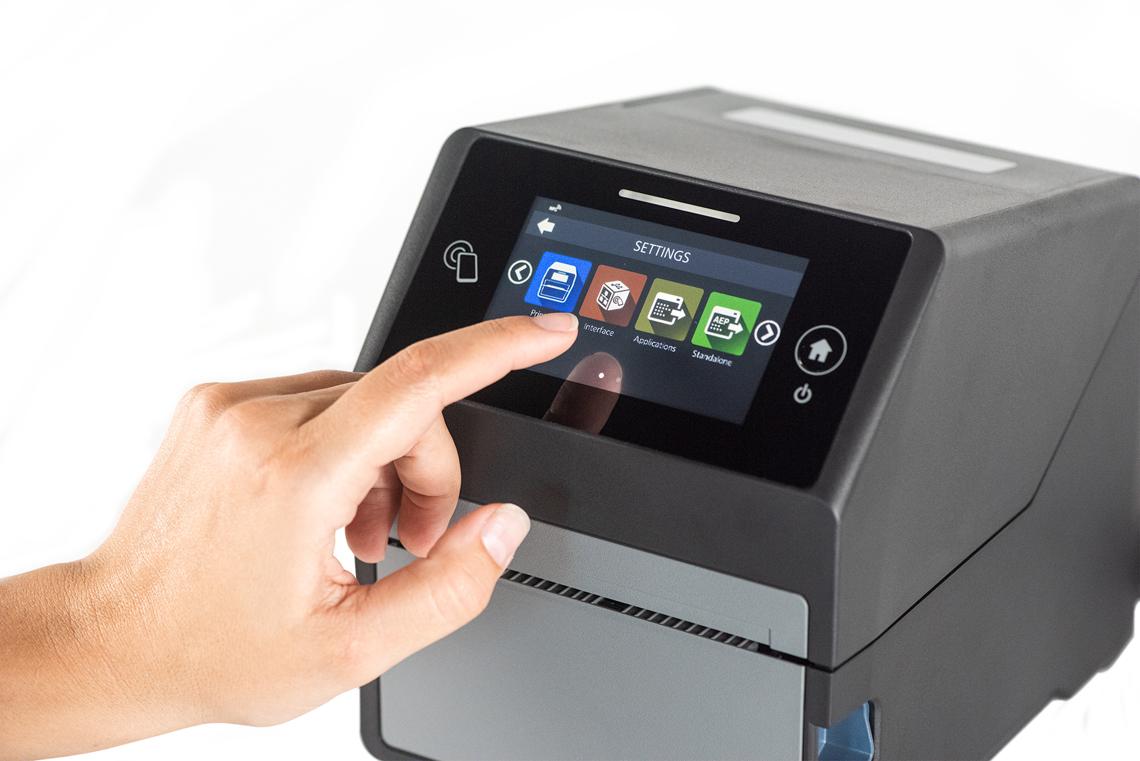
This ease of use is also what led the Lariboisière department to acquire a SATO CT4-LX UHF printer to manage the tagging process internally. It’s “the new generation of standalone, connected, and connectable printers that can operate independently of a computer,” describes Olivier Blanckaert. Staff can enter variable data from the tag directly on the printer and access the data in real time on the department’s network or cloud. The collaboration between RFID Discovery and SATO offers a highly accessible interface and great flexibility of use, both in terms of hardware and software. On a single tag, the SATO CT4LX will print and encode equipment data from the CMMS (Computerized Maintenance Management System).
AP-HP (Paris Public Hospitals) initially began by equipping the Lariboisière site, but “the goal is to tag as much equipment as possible so that RFID becomes standard practice across all AP-HP sites,” explains Laurent Siwiec. The adoption of this solution aims to optimize the work of technicians and improve communication between departments. For example, thanks to RFID, if a department is lacking equipment, it is possible to determine if a neighboring department has the necessary equipment.
POSSIBLE DEVELOPMENTS
To delve deeper into the subject, Nicolas Bellemon envisions potential developments: Ultimately, “it will be possible to locate all the equipment in a hospital, down to the department level,” he asserts. Indeed, by equipping all entrances and exits of the various departments with fixed antennas, it is possible to know where and when medical devices have been used and transported. This is particularly useful for sterilizing operating room equipment: some devices should never leave the operating room. If a piece of equipment is “out of bounds” within the operating room, it would be immediately flagged by a beep, sterilized, and returned to its designated place.
But that’s not all… “SATO’s RFID solutions are designed with the sole purpose of ensuring smarter and more efficient identification. Optimizing asset management and improving the comfort of healthcare staff,” explains Olivier Blanckaert. “Patient safety is also a top priority for us, as we also offer RFID wristbands that align with this approach of improving the patient care pathway.” »
Marie Saunier
[pdf-embedder url=“https://www.sih-solutions.fr/wp-content/uploads/2023/01/012SIHMAGv15p26c.pdf”\]